Photo taken from the video below
The FEBIMA (Federal Bureau for the Investigation of Maritime Accidents - Brussel) has published a report on the investigation into the allision with a gantry crane with the vessel "mv APL MEXICO CITY" on 9th December 2019 in Antwerp.
At the end of the article you will find a link to download the full FEBIMA report.
Watch video about this incident:
The FEBIMA (Federal Bureau for the Investigation of Maritime Accidents - Brussel) has published a report on the investigation into the allision with a gantry crane with the vessel "mv APL MEXICO CITY" on 9th December 2019 in Antwerp.
At the end of the article you will find a link to download the full FEBIMA report.
Watch video about this incident:

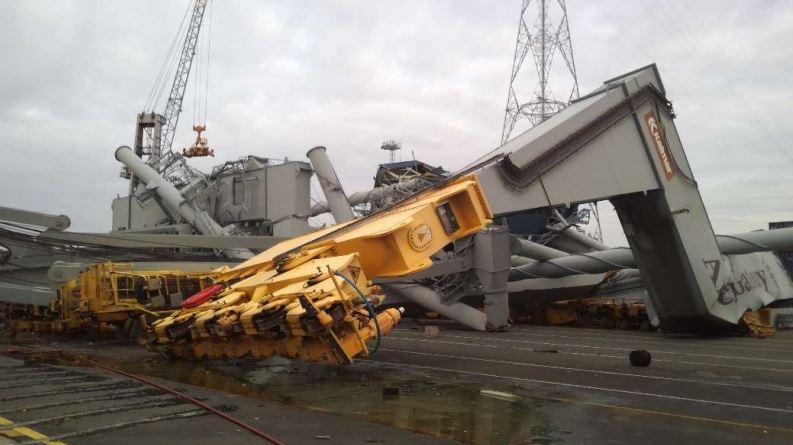
Collapsed gantry crane (Figure 17 from investigation report)
Collapsed gantry crane (Figure 17 from investigation report)
What had happened:
Container ship APL MEXICO CITY broke off her mooring at Doel, Antwerp, in the afternoon Dec 9, drifted across harbor and contacted DP World pier crane. Crane collapsed and was totally destroyed. No injures reported.
Cause of the accident (according to the report from FEBIMA):
"The allision of the mv APL MEXICO CITY with a gantry crane at the Port of Antwerp on 9 December 2019 stemmed from exceptional meteorological conditions and the not availability of tugboats to assist the vessel in remaining alongside as requested by the Master, that have lead to the breaking of seven mooring hawsers on the foreship of the vessel.
Subsequently, in order to gain control over the vessel and prevent damages the main engine of the ship was put ahead. All mooring hawsers at the stern of the vessel broke. The vessel subsequently sailed/drifted onto the gantry crane at the opposite side of the Deurganckdok thereby destroying it. The falling jib of the crane damaged the ship’s hull and propeller, rendering the vessel no longer seaworthy. In the further drifting/sailing onto the river Scheldt, a buoy and dolphin were damaged/destroyed."
Container ship APL MEXICO CITY broke off her mooring at Doel, Antwerp, in the afternoon Dec 9, drifted across harbor and contacted DP World pier crane. Crane collapsed and was totally destroyed. No injures reported.
Cause of the accident (according to the report from FEBIMA):
"The allision of the mv APL MEXICO CITY with a gantry crane at the Port of Antwerp on 9 December 2019 stemmed from exceptional meteorological conditions and the not availability of tugboats to assist the vessel in remaining alongside as requested by the Master, that have lead to the breaking of seven mooring hawsers on the foreship of the vessel.
Subsequently, in order to gain control over the vessel and prevent damages the main engine of the ship was put ahead. All mooring hawsers at the stern of the vessel broke. The vessel subsequently sailed/drifted onto the gantry crane at the opposite side of the Deurganckdok thereby destroying it. The falling jib of the crane damaged the ship’s hull and propeller, rendering the vessel no longer seaworthy. In the further drifting/sailing onto the river Scheldt, a buoy and dolphin were damaged/destroyed."
Damage to the wheelhouse of the mv APL MEXICO CITY seen from inside (Figure 12 of the report)
Damage to the wheelhouse of the mv APL MEXICO CITY seen from inside (Figure 12 of the report)
“Allision with gantry crane with hull damage below the waterline, impairing seaworthiness.”
About FEBIMA:
The Federal Bureau for the Investigation of Maritime Accidents (FEBIMA) is an independent investigating body created after partial transposition of Directive 2009/18/EC of the European Parliament and of the Council of 23 April 2009 establishing the fundamental principles governing the investigation of accidents in the maritime transport sector.
Recommended reading: