Article

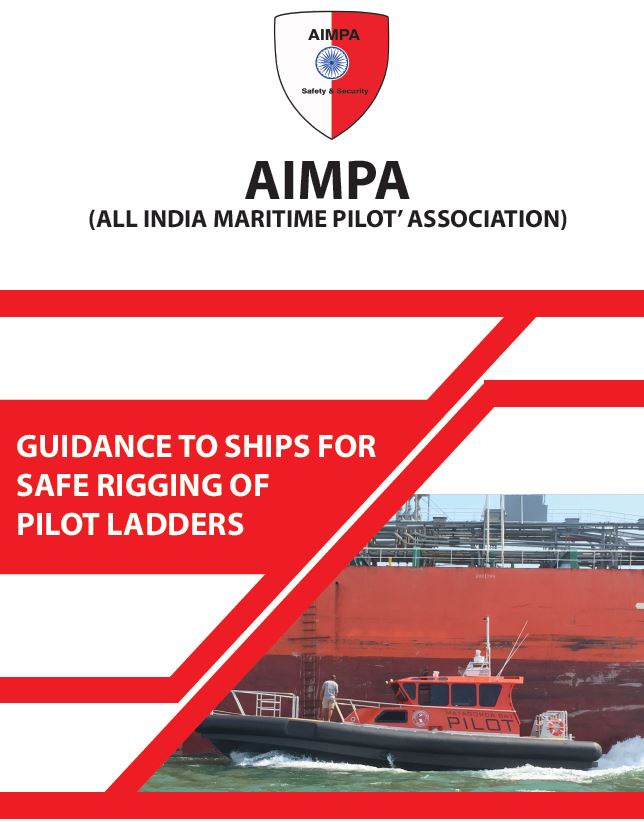
Update: Guidance to ships for safe Rigging of Pilot Ladders (1st May)


by AIMPA - All India Marine Pilots' Association - published on 1 May 2021 369 -

Ships that require the services of a pilot need to ensure that the Pilot Transfer Arrangements (PTA) they provide are in compliance with the requirements prescribed under SOLAS V/23 and IMO Resolution A.1045(27) [as amended by IMO Resolution A.1108(29)].
Click here for a download (Version 1st May 2021)



What's your opinion on this?
Login or register to write comments and join the discussion!
Read more...

Article Shri Sanjay Bhatia releases AIMPA's maiden Marine Pilots' Journal (Download here)

by Capt. Gajanan Karanjikar - Founder President - AIMPA - published on 16 August 2020

Shri Sanjay Bhatia former Chairman of Mumbai Port and Indian Port Association (IPA) expressed pleasure while releasing the All India Marine Pilots Association’s (AIMPA) maiden Issue of “Marine Pilot’s Journal” and applauded the efforts in taking out this kind of Journal to help highlight issues of pilots.

0

Opinion AIMPA has published "Providing Peek into Marine Pilots' World" - Issue II

published on 21 September 2020

The PDF of the second issue is available for download here

0

Opinion AIMPA Journal Issue III - October 2020 for download here

by AIMPA - All India Marine Pilots' Association - published on 24 October 2020

The All India Maritime Pilots' Association has released its new journal for October.

1

Video Operation of POD Ships - Discussion on Efficiency comparing Conventional and IN-OUT POD strategy

published on 8 June 2022

In this movie the efficiency of two different pod operation strategies is compared: With azimuth propeller ships the Pods can be used in two ways to control the speed, e.g. for speed reduction: 1. by adjusting the engine orders, e.g. by reducing the RPMs to get lower speed - this means to drive the ship in the same conventional way as for twin screw vessels, 2. by turning both pods either in- or outward (TOE-IN or TOE-OUT) to reduce the forward thrust and therefore reducing the speed – the...

0

Article Study: Correlation Evaluation of Pilots’ Situation Awareness in Bridge Simulations via Eye-Tracking Technology

published on 21 January 2022

Improvements to pilots’ situation awareness (SA) in maritime navigation are critical to reducing human errors, which have caused 75% to 96% of marine accidents over the last few years.

0

Video M+ Maritime I ECDIS Safety Settings | Full Video | Episode 1

published on 11 July 2020

M+ releases the 1st video of ECDIS competency series on “Safety Settings” presented by Safe Lanes. Use them for training crew, enhance safety standards & professional knowledge. Stay tuned for our upcoming series on ECDIS competency, Anchor losses, Incidents, PCS & vetting preparations & Human Elements training. These “first of it's kind” learning videos are based on PSC & vetting observations to provide solutions & enhance your professional competency. Pls feel free to connect to get a...

2

Video Wind drift making headway - practical experiments for voyage planning and Rule of Thumb

published on 7 April 2021

Another good explaining video from Knud Benedict, ISSIMS

0

Video SIMULATION / MANEUVER OF APPROACH AND MOORING to "TIMBUES" HARBOUR" (BRM - P) BRM Course for #Pilots

published on 4 July 2019

These images show a Navigation drill (SIMULATION) of approach and mooring to one of the Harbours of the Paraná River - "TIMBUES" Harbour (Management and Resources of the Navigation Bridge for Pilots) - (BRM - P) in charge of the Paraná Harbours Pilot, Captain Mr. Diego SCHOTTENHEIM. Exercise carried out in the Navigation Bridge Simulator of the Maritime and Riverine Research and Training Canter (MRRTC), Autonomous City of Buenos Aires #Argentine on March 12, 2019, since 14:50 till 15:55...

0

Video Virginia Pilots Rely on Volvo Penta IPS Propulsion

published on 4 December 2020

The new 56-ft. Virginia Pilots launch is powered by a pair of Volvo Penta D13 700 hp EPA Tier 3 engines matched with IPS-3 steerable pod drives with forward-facing counter-rotating props. The propulsion system includes Volvo Penta’s EVC electronic steering and control system with a three-axis joystick. Top speed is 33+ knots.

0